A Simple Weekly System for Building in Public on LinkedIn and X
Building in public works best as a routine, not a mood. Here is a weekly system for deciding what to post, when, and how to write it all in one sitting.
Most founders who try to build in public stall out after two or three weeks. Not because they run out of things to say, but because every post starts from a blank page and a vague sense that they should be posting more.
The fix is boring: a fixed weekly routine. You decide the kinds of posts ahead of time, you collect material during the week, and you write everything in one block. This post lays out a system you can run in about an hour a week.
Why a system beats inspiration
When you post only when you feel like it, three things happen. You post in bursts, then disappear. You spend more time deciding what to say than saying it. And your updates drift toward announcements, because that is the only time posting feels justified.
A weekly system removes the decision. You already know Monday is a progress update and Thursday is a lesson. All you have to do is fill in the blanks with what actually happened.
The four post types
You do not need a content strategy with twelve pillars. Four recurring post types cover almost everything a founder building in public has to share.
1. The progress update
What you shipped, what you are working on, and what is next. Keep it concrete: name the feature, the bug, the customer request that triggered it. "Shipped CSV export because three people asked for it this month" beats "Big week of improvements!"
2. The lesson
Something you learned the hard way. A pricing experiment that flopped, an onboarding step people kept skipping, a technical choice you would make differently. Lessons travel further than updates because readers can use them even if they never use your product.
3. The behind-the-scenes
A screenshot of your messy Notion board, a rough sketch of a new screen, the actual email you sent to a churned user. This is where building in public earns its name. People follow founders to see how the work really looks.
4. The question
Ask your audience something you genuinely want to know. Which of two onboarding flows would they pick? What do they use today for the problem you are solving? Questions invite replies, and replies are often where you find your next customer conversation.
A sample week
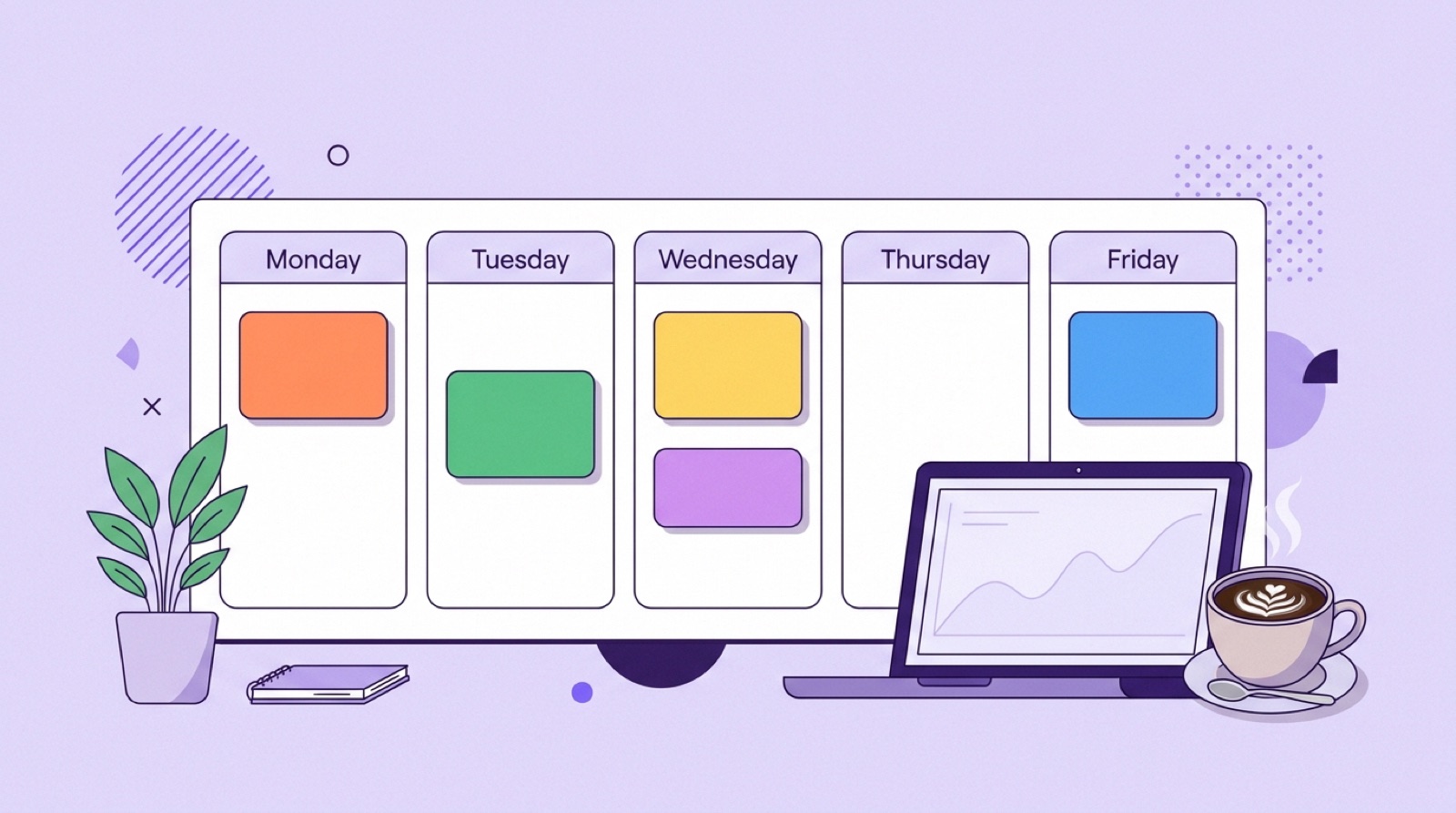
Here is one way to lay those four types across a week. Adjust the days to fit your audience, but keep the rhythm stable so you are not re-deciding it every Sunday.
| Day | X | |
|---|---|---|
| Monday | Progress update | Progress update (short version or thread) |
| Tuesday | Nothing | Behind-the-scenes screenshot |
| Wednesday | Lesson | Lesson as a thread |
| Thursday | Nothing | Question |
| Friday | Behind-the-scenes or question | Weekly recap |
Notice that X gets more posts than LinkedIn. That is deliberate. X moves faster and short posts are normal there, so a quick screenshot or a one-line question fits. LinkedIn posts tend to work better as fewer, more complete pieces. Two or three solid LinkedIn posts a week is a sustainable pace for most founders.
Collect material during the week
The batching session only works if you have raw material. Keep one running note, in whatever app you already use, and drop things into it as they happen:
- Commits or tickets you closed, with one line on why they mattered
- Customer messages that surprised you (remove names before you post anything)
- Numbers you watch, but only ones you are comfortable sharing
- Screenshots of work in progress
- Decisions you made and the alternatives you rejected
Two minutes a day is enough. By Friday you will have more material than you need, and the hard part of writing, figuring out what to say, is already done.
The batching session
Pick one fixed slot each week, say Friday afternoon or Sunday evening, and block an hour. Then work through it in order.
Step 1: Pick your four or five stories (10 minutes). Read the running note and choose one item for each post type. Pick the most specific item, not the most impressive one.
Step 2: Write the long version first (25 minutes). Draft each post at LinkedIn length. LinkedIn allows up to 3,000 characters per post, according to LinkedIn's help center, which is plenty of room to tell the whole story. Writing the full version first makes it easier to cut down later.
Step 3: Cut it down for X (15 minutes). A standard X post holds 280 characters, and X's developer documentation explains that links count as 23 characters and emoji count as two. Either pull out the single sharpest sentence for a standalone post, or split the full draft into a short thread.
Step 4: Schedule everything (10 minutes). Put each post on its day and time. Once it is scheduled, you are done for the week and can go back to building.
If you post to both networks, the cutting step is where most of the time goes. This is the problem PostFounder was built for: you write once, see live character counts for LinkedIn and X side by side, and split the X version into a thread with one click while LinkedIn keeps the full text as a single post.
Pick times and stick with them
People spend a lot of energy hunting for the perfect posting time. For a founder building in public, consistency matters more than precision. Your followers are not a random sample; they are people who know you, and they will get used to when you show up.
A practical approach: choose a time that is morning for the bulk of your audience, post at that time for a month, and then look at what got replies. Move one slot at a time if something is clearly off.
If you schedule natively on LinkedIn, its help center notes you can schedule a post between 10 minutes and 3 months ahead. Either way, the point is to decide once and stop thinking about it.
Keep a short checklist
Before anything goes out, run through four questions:
- Is there one specific detail (a number, a name of a feature, a quote) in this post?
- Would this be useful to someone who never buys from me?
- Did I share anything about a customer or teammate without permission?
- Does the first line make sense on its own?
If the answer to any of those is no, fix it or swap in another story from your note.
What to do when you miss a week
You will miss weeks. A launch slips, a customer emergency eats your Friday, you get sick. Do not try to catch up by posting twice as much the next week. Just restart the routine at the next batching session. A recap post ("missed last week, here is what happened") is a perfectly good progress update.
Start this week
You do not need a big plan to begin. Open a note, start dropping things into it, and block one hour at the end of the week. Write five posts, schedule them, and see what people respond to.
If you want one place to write and schedule for both networks, PostFounder has a free plan and keeps your week on a simple calendar.
Questions
How often should a founder post when building in public?+
A sustainable starting point is two or three posts a week on LinkedIn and four or five on X. Consistency over months matters more than volume in any single week.
Should I post the same thing on LinkedIn and X?+
Post the same story, but adapt the format. LinkedIn suits one complete post, while X usually needs a shorter version or a thread.
What if I have nothing to share this week?+
You almost always do. A small fix, a customer question, or a decision you made counts. A running note you add to daily makes this much easier.
Sources
Schedule LinkedIn and X posts together.
Write once, fit it to each network, and plan the week on one calendar. Free plan, or Pro for $4.99 a month.
Get started for free